In the SDV Era, Copper Faces an Unavoidable Wall of Speed and Distance
2026-06-10 / 07월호 지면기사
/ 한상민 기자_han@autoelectronics.co.kr
.jpg)
INTERVIEW
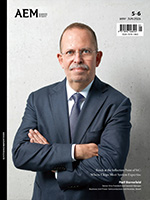
Carlos Pardo
CEO of KD
As Software-Defined Vehicles (SDVs) and autonomous driving continue to spread, in-vehicle data traffic is growing explosively. Copper-based communications, which have dominated automotive networks for decades, are now confronting physical limitations in both speed and distance. Spanish optical communications specialist KD has led the development of the IEEE 802.3cz standard and built an automotive optical networking ecosystem. The company has already secured eight design wins and is currently engaged with more than 40 OEM evaluations across the United States, Europe, and China. According to CEO Carlos Pardo, the transition from copper to optical communications is no longer a distant future—it is already underway.
AEM met with him to discuss the future of automotive connectivity.
By Sang Min Han _ han@autoelectronics.co.kr
한글로보기
Sixteen Cameras: Can Copper Handle the Data?
The automotive industry is rapidly evolving toward SDVs. As a result, limitations in in-vehicle network bandwidth are becoming a major issue.
Pardo: I believe the industry is evolving beyond SDVs toward what I would call the “data-driven vehicle,” which aligns with the direction required by ADAS systems. Modern vehicles can already carry up to 16 cameras, along with LiDAR and radar sensors. The resolution and speed of these sensors continue to increase.
Moving all of this data around the vehicle requires extremely high transmission rates. That is the fundamental reason bitrates are rising so rapidly, and it is forcing the industry to redefine the entire vehicle network architecture.
What are the limitations of traditional copper-based communication technologies, and why should optical technology now be considered the alternative?
Pardo: The easiest way to understand copper’s limitations is to look at data centers. There are two factors driving the transition from copper to optical networking there: speed and distance.
Copper has inherent speed limitations due to the frequency response characteristics of the cable itself. As data rates increase, the distance that can be covered decreases. Optical communication, on the other hand, can easily handle distances of 40 meters, 300 meters, or more.
There is also another issue. At high speeds, achieving EMC (electromagnetic compatibility) compliance with copper becomes extremely complex.
Optical Communication Designed for Automotive Use from Day One
What are the core technological differentiators of KD’s Optical Multi-Giga Technology?
Pardo: There are three key elements.
First is system design. When we began standardization efforts five or six years ago, we designed the IEEE 802.3cz standard specifically for harsh automotive environments, including temperature extremes, humidity, vibration, and dust. Securing sufficient link budget was critical. The important point is that the communication system was designed for automotive use from the beginning.
Second is implementation. We fully integrated all transceiver electronics into a single package. It can be assembled just like a conventional component. This approach enables both low cost and high robustness.
Third is the ecosystem. We have built an ecosystem around our technology with connector manufacturers, fiber suppliers, and test-equipment providers.
Compared with copper, our system delivers much higher speeds and longer distances with greater robustness. From an implementation perspective, integrating everything into a single component, combined with lower-cost fiber and connectors, ultimately results in lower system costs. The ecosystem itself also provides a competitive barrier because major fiber and connector suppliers are already working with us.
Automotive components face demanding reliability requirements, including vibration and extreme environmental conditions. How has KD overcome durability concerns often associated with optical cables?
Pardo: There is a perception that optical communications are fragile, but that is only true if you look at a bare optical fiber. A single strand can easily break.
However, automotive-grade fiber cables are protected by robust outer jackets. In practice, they are extremely durable—arguably more durable than copper. Copper cables eventually fail after repeated bending, whereas optical fibers can withstand millions of bending cycles.
From a system-design perspective, we built optical link budgets two to three times larger than those typically used in data centers. Even though automotive links are shorter, we wanted sufficient margin to absorb performance degradation caused by plastic aging, connector misalignment, and other factors over the product’s lifetime.
Even the laser, often considered the most vulnerable component in an optical system, was designed and validated from the outset to operate from –40°C to 125°C, withstand thermal cycling, and last for 15 years.
Honestly, I believe our solution is now more robust than copper.
Why Must Vehicles Move Toward Optical Communications
.jpg) The rapid growth of cameras and sensors is driving a surge in in-vehicle data traffic,
The rapid growth of cameras and sensors is driving a surge in in-vehicle data traffic,
raising the prospect of a transition from copper-based automotive Ethernet networks to optical connectivity.
Twenty Percent Cheaper Than Copper, with No EMC Concerns
What economic benefits can OEMs and Tier 1 suppliers gain from adopting KD’s technology?
Pardo: There are four main advantages.
First, link cost. If you compare transceivers, connectors, and fiber directly against copper, our integration approach typically results in about 20% lower cost.
Second, EMC cost reduction. Optical communication simply does not have EMC issues. Designing high-speed copper networks requires special routing, ferrite cores, and extensive engineering effort. None of that is necessary with optical networking.
Third, traffic aggregation. Suppose two cameras are installed on one side of the vehicle. With copper, each camera requires a separate cable. With optical networking, both camera streams can be aggregated and transmitted over a single link. This significantly simplifies the network architecture.
Fourth, future scalability. Optical systems can support everything from 1 Gbps to 100 Gbps using the same connectors and fibers. Copper becomes increasingly complex at higher speeds, requiring new cable specifications, parallel lanes, and different connectors. Optical networking keeps the same physical infrastructure regardless of speed, reducing complexity and cost.
Where do you see the realistic boundary between coexistence and replacement of copper by optical networking?
Pardo: Companies such as Marvell, Broadcom, and NXP remain focused on copper, and there is a reason for that. They know optical networking will eventually be necessary, but their resources are currently concentrated on AI-related optical engineering rather than automotive optics. KD is addressing that gap.
The transition point from copper to optical networking is driven by two factors: speed and distance.
As sensor bitrates continue to increase and traffic aggregation becomes more common, networks will need to move beyond 10 Gbps toward 12, 25, and even 50 Gbps. At that point, copper’s EMC challenges and costs become major constraints.
Distance is the other factor. As speeds rise, copper’s maximum transmission distance decreases. In applications requiring distances greater than seven meters—such as trucks and buses—optical communication is already becoming necessary.
Convincing the Industry: More Than Just the Technology
The automotive industry is known for being conservative. What ultimately convinced major partners to move forward?
Pardo: I agree that OEMs are conservative, but I see two categories.
One group already understands that rising bitrates will inevitably require optical networking and has begun evaluations and concept development. Some OEMs are already developing vehicles that incorporate optical communication.
The other group is still watching and waiting for others to move first.
The reality is that we have already secured eight design wins. Vehicles in the United States, Europe, and China have already committed to using optical networking.
Some OEMs take a phased approach, introducing a single optical link first, testing it for one or two years, and then expanding deployment. I think that is a smart strategy.
At present, more than 40 OEMs are either conducting proof-of-concept evaluations or working through design-win processes. Most OEMs are already testing the technology. This is not a future possibility—it is happening now.
Lessons from MOST: Openness and Integration
When KD was founded in 2010, automotive optical networking seemed to be a field abandoned after MOST declined. Why revisit it?
Pardo: When we founded the company in 2010, we were convinced that the automotive industry would eventually adopt optical communication.
MOST used plastic optical fiber (POF) and red LEDs. We began by trying to maximize the capabilities of that medium. While MOST remained at 150 Mbps, we developed a 1 Gbps solution and made it significantly more robust.
When we analyzed why MOST declined, we found two main reasons: cost and monopoly.
The ecosystem was dominated by SMSC (now part of Microchip), making second-source suppliers difficult to establish. We therefore committed from the start to open standards and to building an optical system that would be cheaper and more robust than copper.
That is why we developed our own optical devices and pursued complete integration from the beginning.
What was the greatest technical challenge you faced, and how did you overcome it?
Pardo: Technically, the biggest challenge in achieving 1 Gbps was LED nonlinearity.
The LEDs we were using were not sufficiently linear, which prevented performance beyond 150 Mbps. To solve this, we developed new mathematical and algorithmic techniques that compensated for channel nonlinearity directly within the chip.
That breakthrough was essential for reaching 1 Gbps.
Commercially, the biggest challenge was the conservatism of the automotive market. It is not an industry that readily embraces newcomers. Convincing the industry that we were a reliable partner with robust technology took time.
Today, however, we have sold millions of ports, and many vehicles are already operating with our 1 Gbps technology. Consistent messaging, leadership in standardization, and positive technical evaluations made that possible.
.jpg) The Transition Has Already Begun
How is KD involved in standards development today?
The Transition Has Already Begun
How is KD involved in standards development today?
Pardo: From the beginning, we knew standardization was essential.
The automotive industry no longer favors proprietary solutions. Both our 1 Gbps and multi-gigabit technologies were developed as IEEE and OPEN Alliance standards, and we actively led those efforts.
We are also deeply involved in ISO activities related to cables, connectors, and test methodologies.
Without participation in standardization, a technology company cannot succeed in this market. The result of those efforts is the standards we have today. They are published, and the industry is increasingly aligning around them.
What remains to be done before a complete automotive optical ecosystem is established?
Pardo: Honestly, I believe the ecosystem is already in place.
There are transceiver suppliers beyond KD, multiple connector manufacturers, fiber suppliers, and test-equipment companies.
The final step is component qualification. We are currently working with cable, connector, and fiber suppliers to complete qualification activities. Once that process is finished, mass production can begin immediately. We expect completion next year.
Regarding Korea, what concerns me is the lack of domestic suppliers capable of developing connectors and harnesses. Most connector and fiber suppliers are currently overseas companies.
It is also unfortunate that Korean OEMs and Tier 1 suppliers have not yet decided to test even a single optical link. Because the industry is moving quickly and much of the development is confidential, there is a risk that Korea could fall behind in the transition to optical networking.
China, Competition, and the Road Ahead
What is happening in China regarding automotive optical networking?
Pardo: The emergence of alternative optical networking proposals in automotive applications actually validates our belief that optical communication becomes essential as speeds increase.
China has a strong optical industry and is producing many proposals, which is a positive development.
However, our message to China is simple: IEEE 802.3cz was designed from the beginning for automotive environments. It provides sufficient link budget, high-temperature durability, and validated 15-year reliability.
Simply adapting data-center transceivers is unlikely to satisfy automotive requirements. We welcome optical adoption, but it should be based on standards specifically engineered for vehicles.
When will optical networking become the dominant in-vehicle connectivity technology?
Pardo: It is already happening.
The driving forces are speed and distance requirements. But there is another factor. Once OEMs begin using optical networking, they discover that it is more robust, simpler, and cheaper than copper.
As a result, they will want to use it even for lower-speed links. The same transceivers, connectors, and fibers can support speeds from 1 Gbps to 100 Gbps.
I believe we are already approaching the tipping point at 10 Gbps and 25 Gbps. Once optical networking is adopted for high-speed links, the psychological barrier to replacing copper disappears, and deployment naturally expands into lower-speed applications.
The future vehicle will not be a bundle of copper wiring. It will be a vehicle connected through optical networking—a vehicle that is more robust, lighter, cheaper, and better prepared for the future.
That is the legacy I hope this technology leaves for the automotive industry.
A Final Message to Korean Readers
Pardo: In-vehicle optical networking represents the future of high technology in automobiles.
Staying with copper limits what vehicles can achieve. Fully autonomous vehicles and robotaxis will require an optical backbone that enables those capabilities efficiently and cost-effectively.
Remaining dependent on copper limits the development of physical AI within vehicles.
I believe Korea needs to accelerate. China, the United States, and Europe are all moving quickly toward optical adoption.
My advice is simple: start by testing a single link. Once you see how well it performs, you will want to use it in many more places
AEM(오토모티브일렉트로닉스매거진)
<저작권자 © AEM. 무단전재 및 재배포 금지>



.jpg)
.jpg) [ICS] 10BASE-T1S 무료 교육 (매월 둘째 주 금요일)
[ICS] 10BASE-T1S 무료 교육 (매월 둘째 주 금요일)