


.jpg)
China is moving to expand C-V2X direct communication from commercial vehicles to motorcycles and other vulnerable road users, backed by a nine-ministry national plan. India is proposing V2V for every new L-, M-, and N-category vehicle from 2028, while Japan has set a timetable for the V2X infrastructure and spectrum policy supporting Level 4 automated driving. As Asia moves V2X from pilot projects toward safety requirements, Korea has produced something else: a plea to save an industry it has already built.
By Sang Min Han _ han@autoelectronics.co.kr
한글로보기
A motorcycle approaches from the right at an intersection. The car's camera can't see it — a parked truck is blocking the view, and the radar hasn't picked it up either. But the car already knows where the motorcycle is, how fast it's moving, and which way it's headed. The motorcycle announced itself through C-V2X direct communication.
That scene isn't common on Chinese roads yet. But work has begun on a standard that could help make such a scene possible. On August 10, 2026, the China Chamber of Commerce for Motorcycles announced that "Technical Requirements and Test Methods for C-V2X Direct Communication Systems for Motorcycles and Mopeds" had been added to this year's first batch of group-standard projects, under project number 2026-19. The Tianjin Internal Combustion Engine Research Institute and the Tianjin Motorcycle Technology Center are leading the drafting. The lead institution has long been involved in drafting national standards for China's motorcycle sector.
It isn't a finished standard, and it isn't mandatory. It has cleared initial review and entered the drafting pipeline. But what it's aiming at is clear. C-V2X direct communication, until now framed almost entirely around cars and road infrastructure, is being extended to motorcycles and mopeds. A two-wheeler that used to be something a car's sensors had to spot becomes something that broadcasts its own position and motion.
A source familiar with V2X work in China's auto industry told AEM that the country's industry wants to extend C-V2X coverage to vulnerable road users, or VRUs. The standard started inside the motorcycle sector, the source said, but it's being developed in close coordination with the China Academy of Information and Communications Technology (CAICT), and could eventually grow into a national standard applied broadly to vehicles. Early use cases, the source added, will likely center on the VRU scenarios defined under C-NCAP 2027. The goal isn't to replace a car's camera, radar, or lidar — it's "adding one more layer of safety for VRUs."
A motorcycle passing a truck, a two-wheeler pulling out from behind a parked car, a moped sitting in a blind spot — these are hard targets for a car's sensors. They're small, they move fast, and they change direction without warning. Once a building or another vehicle blocks the view, no amount of sensor performance helps. C-V2X isn't a sensor that sees the invisible. It's a separate channel that lets the other party announce itself first, over radio.
Seven Seconds, Starting With Trucks
The motorcycle standard didn't appear on its own. China had already started building the foundation for C-V2X adoption in commercial vehicles.
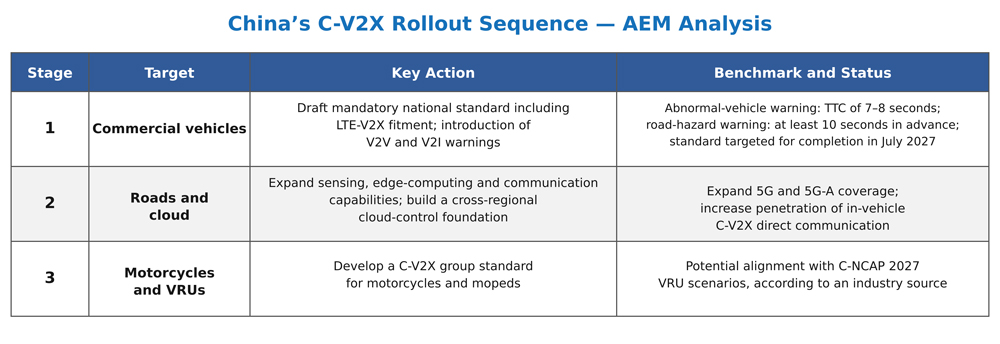
AEM previously reported that China's Ministry of Transport had opened public comment on a draft mandatory national standard that would require LTE-V2X direct communication systems in commercial vehicles. Article 4.6 of the draft "Technical and Management Requirements for Commercial Vehicle Operating Safety" would require commercial vehicles, trailers excluded, to carry direct-communication systems that deliver vehicle-to-vehicle and vehicle-to-infrastructure safety warnings.
The starting point was narrow: a "disabled-vehicle warning," triggered when a vehicle ahead sends a hazard-light or flat-tire signal, and a "road-hazard warning," triggered when a roadside unit (RSU) flags a collapsed road, ice, or a slick surface. The performance requirements were specific. A disabled-vehicle warning has to arrive at least 7 seconds ahead at 60 km/h and 8 seconds ahead at 80 km/h. A road-hazard warning has to arrive at least 10 seconds before the vehicle reaches the hazard.
In January 2026, at China's Yancheng proving ground, testers ran a truck at 60 km/h through simulated rain of more than 50mm per hour and fog cutting visibility to under 50 meters. With LTE-V2X switched on, the driver got a warning more than 7 seconds before a potential collision. Under the same conditions, with V2X off and only automatic emergency braking (AEB) running, the test vehicle failed to detect the target in time. AEB never engaged, and the vehicle hit it.
That result shouldn't be read as proof that V2X beats AEB. What V2X did in the test wasn't braking — it was a voice alert. The driver still had to hit the brakes. What mattered was different: when rain and fog blinded the sensors, a second channel still got the warning through.
China didn't leave those seven seconds as a demonstration. It put commercial vehicles first in line for regulation — vehicles with high crash risk, long duty cycles, and long stopping distances when fully loaded. Once the standard is finalized, it will apply, after a grace period, to vehicles newly entering commercial service. Completion is targeted for July 2027. The drafting notes also lay out an industrial rationale: build demand for equipment at the point of manufacture, scale up production of chips, modules, onboard units, and roadside units, and eventually extend the same communication base to platooning and autonomous freight.
The open question was always which vehicles and which safety scenarios come first. China's first answer was commercial vehicles, disabled vehicles, and road hazards. Its second answer is motorcycles and vulnerable road users. A stalled truck hidden by fog and a motorcycle hidden at an intersection are different hazards, but the underlying logic is the same — get the warning to the car in the moment its own sensors can't.
The Nine-Ministry Plan Between Two Announcements
Looked at on its own, the motorcycle standard reads like a niche project inside the two-wheeler industry. Set beside the national plan that followed a month later, it reads differently.
On September 10, China's Ministry of Industry and Information Technology, together with the National Development and Reform Commission, the Ministry of Public Security, the Ministry of Transport, the Ministry of Commerce, the Ministry of Natural Resources, the Ministry of Housing and Urban-Rural Development, the State Administration for Market Regulation, and the Cyberspace Administration of China, released the "15th Five-Year Plan for the Development of the Intelligent Connected New Energy Vehicle Industry". The plan sets a goal of highly automated driving on highways, urban expressways, and some city streets by 2030, with autonomous-capable vehicles deployed at scale. It states outright that the safety of vehicles running autonomous systems should exceed that of human drivers by a wide margin.
C-V2X is written in as the communication layer underneath that goal. The plan calls for expanding 5G and 5G-A coverage in major cities and on select highways, building out roadside units for C-V2X direct communication, raising the share of vehicles equipped with 5G/5G-A and C-V2X, and digitizing traffic signals, signs, and lane markings.
Read as a flow, the plan links four elements. First, major intersections and road segments get sensing, edge computing, and communication capability. That data flows up into a cloud control layer spanning cities and highways. The cloud processes traffic-control and incident data and sends it back down to vehicles. Once that loop runs at scale, vehicle-to-vehicle and vehicle-to-road cooperative sensing and decision-making start operating as a system, not a pilot. This is what China means by "vehicle-road-cloud integration."
None of this reads like a plan to install a few dozen roadside units. It ties vehicle penetration rates, road digitization, communication infrastructure, cloud platforms, and cooperative decision-making into a single rollout. The intent is to widen the range of information a car draws on, from what it senses itself to what surrounding vehicles, the road, and the cloud can tell it.
That's where motorcycles come in. Cars and roadside units can talk to each other all they want — if the motorcycle on the road isn't part of that loop, a blind spot remains. Against the vehicle penetration targets and roadside-unit buildout in the nine-ministry plan, the motorcycle standard looks like a small story. But it points to one of the critical missing pieces that must be connected before the network can function as a broader safety net.
What's Left for Automakers
Motorcycle C-V2X isn't a problem for the motorcycle industry alone. If a car can't receive the message and act on it, the safety function doesn't exist. Message reception and authentication, ADAS sensor fusion, hazard assessment, driver alerts, false-alarm management, cybersecurity, functional safety, and vehicle-level validation all have to be built on the vehicle side. If braking or evasive maneuvers eventually connect to it, liability boundaries and safety requirements would also have to be revisited.
What information and functions come first is something only the published standard will settle. But if it lines up with C-NCAP 2027's VRU scenarios, as the source suggested, passive reception by the vehicle may not be enough. The emerging motorcycle standard would not only define requirements for transmitting devices; it would also pose a question for automakers: how should ADAS trust and act on this new category of external information?
China's sequencing has come into focus. Build early installation demand in commercial vehicles, where the risk and social cost are highest. Use the national plan to raise roadside-unit coverage and vehicle penetration together. Then widen the pool of connected road users to motorcycles and VRUs, the ones cars are most likely to miss. Regulation creates the vehicles, the vehicles raise the return on infrastructure spending, and the infrastructure raises the value of putting the equipment in the vehicle in the first place. China is solving V2X's old chicken-and-egg problem by deciding the order.
India Targets Every New Vehicle, Japan Builds for Level 4
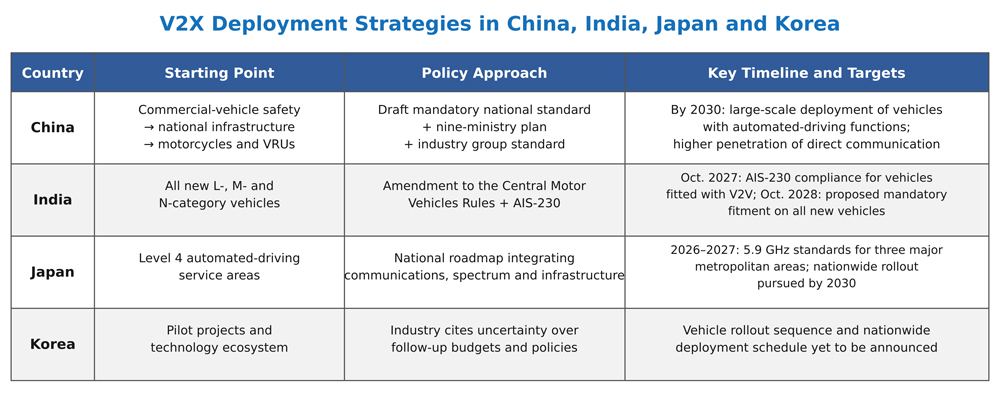
China isn't the only one moving. India's Ministry of Road Transport and Highways is pushing C-V2X-based V2V through an amendment to the Central Motor Vehicles Rules. Under the draft, L-, M-, and N-category vehicles manufactured on or after October 1, 2027 would have to comply with AIS-230 if equipped with V2V. From October 1, 2028, all newly manufactured vehicles in those categories would be required to carry an AIS-230-compliant V2V system.
L category covers two- and three-wheelers. Where China is writing C-V2X requirements specifically for motorcycles and mopeds, India is setting a single deadline across two-wheelers, cars, buses, and trucks all at once. If the amendment goes through as drafted, India could become the first major auto market to mandate C-V2X-based V2V across its entire new-vehicle lineup.
Japan took a different route. In July 2026, its Ministry of Internal Affairs and Communications released a "Communications Infrastructure Strategy for an Autonomous Driving Society," drawing a clear line between 4G/5G mobile networks and V2X direct communication. Mobile networks handle wide-area information and cloud connectivity; V2X direct communication handles safety-critical data — signals, intersections, merge points, blind spots — that needs low latency and high reliability. Japan plans to expand Level 4 services around 13 designated commercialization zones and major expressways, and to finalize 5.9GHz V2X technical standards and communication specs for the Tokyo, Nagoya, and Osaka metro areas between 2026 and 2027, ahead of relocating existing 5.9GHz stations and rolling the standard out nationwide by 2030.
China is pushing vehicle equipage and roadside-unit deployment through regulation. India has proposed a deadline for V2V across every new vehicle. Japan has folded communications, spectrum, infrastructure, and Level 4 services into a single national schedule. The three approaches aren't the same. China is opening its market through high-risk vehicles and specific warning functions. India is trying to lay a common communication base across its entire two-wheeler and automotive market at once. Japan is matching infrastructure to the roads and regions where autonomous service is actually needed. What they share is this: none of them are just running more pilot programs anymore. Each has started deciding which vehicles, on what spectrum and standard, starting when.
From Korea, a Plea
While China's motorcycle announcement and nine-ministry plan followed one after another, and India and Japan laid out their own timelines, what came out of Korea wasn't a new rollout plan. It was an industry plea to save what already exists.
"The uncertainty and loss of momentum in Korea's V2X policy over the past several years put the technological capabilities and global competitiveness we spent more than a decade building at risk of collapsing almost overnight."
Sungsoo Hong, chief business officer of Ettifos, which serves as a vice-chair member of the Korea C-ITS Association, sent an open letter to Korea's Ministry of Land, Infrastructure and Transport, Ministry of Science and ICT, and Ministry of Trade, Industry and Energy shortly after China's 15th Five-Year Plan came out. Over the past decade, he wrote, Korea built a rare, vertically integrated V2X industry — from fabless modem chipsets through modules, RSU and OBU hardware, to services and software.
He went on to say that with no clear government commitment, follow-up policy, or budget in sight, Korean companies are giving up on the business one by one, some leaving the domestic market and others turning abroad simply to survive. Rebuilding a supply chain, a workforce, and companies once they're gone, he warned, would take far more time and money than keeping them running now. His view can't stand in for the whole Korean V2X industry. But set next to what China, India, and Japan are doing, it makes clear exactly what he's afraid of.
Korea has already tested C-ITS and LTE-V2X, and it has developed communication chips, modules, base stations, and terminals. The question of whether the technology works was settled a long time ago. What's still missing is a decision — which vehicle group gets which safety function first, and in what order vehicle equipage and road infrastructure get built out.
That's why the gap between China and Korea can't be explained by technology alone. China is building initial demand in commercial vehicles, using its national plan to set the direction for vehicle and road rollout, and now working to connect motorcycles and VRUs on top of that. India has proposed an October 2028 deadline. Japan has set a region-by-region schedule for Level 4 service and 5.9GHz infrastructure. The seven-second warning a truck received at the Yancheng proving ground wasn't a win for one piece of technology — it was proof that another path can carry a warning through even when a car's own eyes are blocked. China moved that seven seconds into commercial-vehicle regulation, then into national infrastructure, and is now working to connect the motorcycles a car still can't see. The question left for Korea isn't whether C-V2X is needed. It's which vehicles and which safety scenarios get the technology it already has — and when that first date will be set.
AEM(오토모티브일렉트로닉스매거진)
<저작권자 © AEM. 무단전재 및 재배포 금지>
.jpg) [ICS] 10BASE-T1S 무료 교육 (매월 둘째 주 금요일)
[ICS] 10BASE-T1S 무료 교육 (매월 둘째 주 금요일)